Pages

Saturday, January 8, 2011

Bring back the dead~~!

The tech-da-hack team has realized that in this fast paced world, actions of people are sometimes quicker than their thinking. In the process of their quick decision making, they sometimes delete their important data....be it music,pictures,movies,or any valuable document!

So we decided to show our readers the path to two very good tools to undelete the files that they had deleted. But first we must understand that how a file is deleted by an operating system.

Whenever a user deletes a file,the OS(Operating System) just simply removes the link to that file. It means that the file is still present at its original physical location on the hard drive,but is no more visible to the user. If somehow this link is re-created,then the file can be accessed again!!

The files reside at their location only if that portion of the hard-disk has not been re-written by any other data. So softwares that perform such task, are more efficient for the most recently deleted files.

The following two tools are good for this purpose,and have been tested by our team:


1. Recuva(Free)

This is a free data recovery software, but they do accept donations if you wish to make one, so as to keep on providing such great softwares in the future.

Screenshot-1

Screenshot2


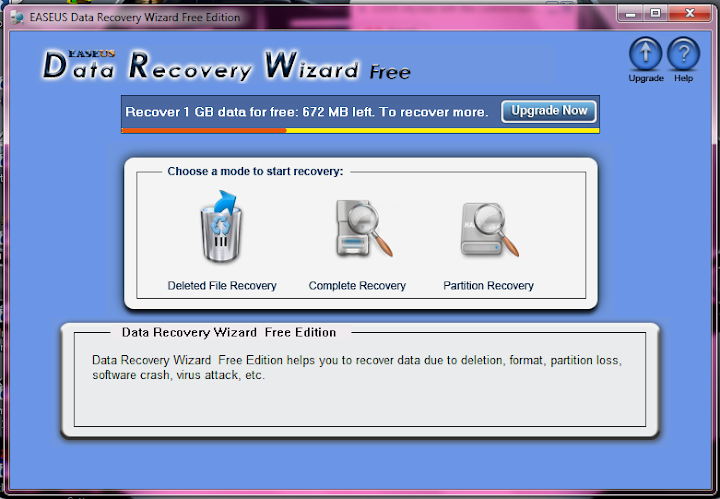
2. EASEUS Data Recovery(Free recovery of 1GB data)

This software is a free software which allows data recovery of total 1GB. After that you'll have to purchase the full version. This is simlar to trial software, but the criteria here is data limit.

Screenshot1


These are free(sometimes for limited data), easy to use and easily available tools. You just have to download either of them and install it on your computer.

For your convenience, you can click on the name of the software mentioned above, to download their setup.

After the installation of the software, you'll notice that the procedure of restoring back the deleted files is very easy. Open the software, select the file(s) type you want to recover and then follow the instruction carefully and thus you get back the file. These tools can undelete all type of files ranging from a mere KB(kilobyte) in size to even some GB(gigabyte). So basically you can undelete anything ranging from a text file to a movie which you accidentally or purposely deleted.

You can also use this to see what was there in your friend’s pendrive or what data did he transfer using that particular drive. Such tools are very important for cyber-forensic experts.


We hope you do enjoy undeleting your deleted files!!


Do let us know, in the comments, if this post has helped you in recovering any of your important file.

White House Attacked !!!


A simple Christmas Card e-mail from White House but it was an attack by
cyber criminals to steal sensitive data. The e-mail had a link which asked the recipients to click on it then it would download the Zues Malware. It is a known malware that was created years ago and used to steal passwords and other online credentials, primarily to get the Internet Banking Information .It has already been used to steal millions of dollars. In the case of White House it downloaded a second payload that is designed to steal documents from the recipient's computer thus, accessing Microsoft
Office and Excel files. Due to this the hackers were able to use the e-mail to collect sensitive law enforcement data but there is no proof that important data were stolen.
This e-mail raises the question on White House Cyber Security which is trying to increase their cyber security to the optimum level since Wikileaks
exposure of their sensitive data which showcased the world their truth.

Article posted by:Shipra Sahai

Wednesday, January 5, 2011

Android gets a Vulnerability!!

A new vulnerability in Android based web browser has been found which allows attackers to access the contents of files stored on the device's SD card, credentials stored in the browser, browser history, spy on your web transactions, even in encrypted.


The vulnerability is present in a code written by software company PacketVideo; contributed an open version of their core multimedia application to Android where it became the multimedia subsystem for the Android web browser. Google says that a fix will be released as soon as it will be available.

HTC Desire, Google Nexus One, Samsung Galaxy Tab etc. (even with Android 2.2) are vulnerable to this kind of attack.

Tips to protect you from hacking until Google issues a security patch:

1)Do not use the Android web browser. If this is not possible, only visit trusted sites and only over the T-Mobile network (avoid Wi-Fi). Use browser such as Opera Mobile; which prompts the user before downloading files.


2)Disable JavaScript in the browser.

Check for suspicious automatic downloads, which should be flagged in the notification area. This shouldn’t be happening completely in the background.


3)Unmounting the SD card.


We thank our loyal reader Shipra
Sahai for providing us with this article

Tuesday, December 28, 2010

Hope 2011 is better!!

Recently security vendor Bit9 released its annual "Dirty Dozen" list. According to statistics obtained from International Institute of Standard and Technology and International Vulnerability Database, it lists top 12 software with most vulnerabilities for 2010. From January to October this year, Google Chrome browser vulnerability has been discovered up to 76, which tops the list.

Besides Google Chrome, Apple's Safari browser and Microsoft Office's vulnerabilities are also getting more exposure, respectively 60 and 57 in the past year, ranking second and third. The software included in the list are frequently used. Here is the specific list:

1. Google Chrome, 76 vulnerabilities;
2. Apple Safari, 60 vulnerabilities;
3. Microsoft Office, 57 vulnerabilities;
4. Adobe Acrobat, 54 vulnerabilities;
5. Mozilla Firefox, 51 vulnerabilities;
6. Sun JDK, 36 vulnerabilities;
7. Adobe Shockwave Player, 35 vulnerabilities;
8. Microsoft IE, 32 vulnerabilities;
9. RealNetworks RealPlayer, 14 vulnerabilities;
10. Apple Webkit, 9 vulnerabilities;
11. Adobe Flash Player, 8 vulnerabilities;

12. Apple Quicktime and Opera browser, 6 vulnerabilities.


Article from: Top 12 Software with Most Vulnerabilities for 2010

Tuesday, December 21, 2010

Easy access using the new App!

Now you can visit this site more frequently without the need to open a web browser.
We at tech-DA-hack have created an app for our readers. This app is available in the Ovi Store and is called "Tech-da-hack". At present, the app is available only for users of Nokia mobile, but we are determined to create apps for other mobiles as soon as possible. We at tech-da-hack are eagerly waiting to hear from our readers about this app as it would surely motivate us towards creating app for other mobiles too, as soon as possible.
We believe that the app would definitely provide a decrease in your access-time towards this site.
We would like to request our readers to download the app and also post reviews so that we can improve the application.
Even though it is still a basic app which provides all our posts with options to share the posts with your friends via e-mail and/or SMS, we would like to add more functionalities.

Hoping to see a lot of downloads!!

You can find the app at: http://store.ovi.com/content/79876

Tuesday, December 14, 2010

GPRS hack- Not Illegal !!

 We at tech-DA-hack believe that anything that we do bypassing the usual way, can be termed as hacking. Accessing the Internet from your mobile is also a form of hacking, as we'll access it in a form other than the one that the operators want us to. And the best part is, this is completely legal!!

So we at tech-DA-hack are bringing this post so as to help our readers with the GPRS settings on their mobile phones. We are providing the settings in their general form. If you face any problem, then kindly post a comment and we’ll help you in configuring your mobile easily.

As a matter of fact, even the customer care executives will not be able to help you so easily!!!

We are also providing a PDF file so that you can always keep the settings handy in the form of the pdf file.

The PDF file can be found at this location: http://rapidshare.com/files/436844646/GPRS_Settings.pdf


AIRCEL:

                             APN:               aircelwap

                             PROXY:          Enabled

                             IP:                    172.17.83.69

                             PORT:             8080


AIRTEL:

                             APN:               airtelgprs.com


BSNL:

                             APN:               bsnlnet


IDEA:

                             APN:               internet


RELIANCE:

                             APN:               rcomwap

                             IP:                    010.239.221.005

                             PORT:             8080


UNINOR:

                             APN:               uninor

                             PROXY:          Enabled

                             IP:                    010.058.010.058

                             PORT:             8080


VODAFONE:

                             APN:               portalnmms

                             PROXY:          Enabled

                             IP:                    010.010.001.100

                             PORT:             9401 or 9201


VIDEOCON:

                             APN:               vinternet.com


--------------------------------------------------------------


Saturday, December 4, 2010

Potential WikiLeaks Phishing Scams

We at tech-DA-hack have recieved an informational email from US-Cert regarding the phishing scams related to the Wikileaks website.The important portion of the mail that we received from the US-Cert website is mentioned here:

"In the past, US-CERT has received reports of phishing scams and
malware campaigns related to topics that are of high-interest to the
U.S. Government or news media, such as the WikiLeaks website. Users'
systems have been compromised by receiving and accessing phishing
emails with subject lines that seem relevant to a high-interest
subject and appear to originate from a valid sender. US-CERT reminds
users to remain vigilant for potential malicious cyber activity
seeking to capitalize on interest in WikiLeaks. Users are advised to
exercise caution in handling any email with subject line, attachments,
or hyperlinks related to WikiLeaks, even if it appears to originate
from a trusted source.

Users must take the following
preventative measures to protect themselves from phishing scams and
malware campaigns:

* Do not follow unsolicited web links in email messages.
* Use caution when opening email attachments. Refer to the Using
Caution with Email Attachments Cyber Security Tip for more
information on safely handling email attachments.
* Maintain up-to-date antivirus software. "